


Blade Flexibility – FLEX
What is FLEX?
FLEX indicates the force required to bend a blade in a buckling test, expressed in kilograms. A lower value means the blade bends under less force, while a higher value indicates greater resistance to bending.
What Does FLEX Tell Us?
Manual testing can produce different results for the same sword due to variations in pressure, alignment and handling. Our guided mechanism is designed to improve measurement consistency.
Blade geometry, mass distribution, the way the blade bends and the fencer’s technique all influence its performance and safety.
Important: Before entering a tournament, always check the organiser’s current equipment requirements and testing procedure. FLEX values obtained using different methods may not be directly comparable.

Polish HEMA Federation rules
All ENSIFER sparring models meet the equipment requirements set out in the Polish HEMA Federation rules.
Polish HEMA Federation rules →How We Measure FLEX
At ENSIFER, we use a dedicated testing device with a vertically guided mechanism and a pivoting pommel support. Axial pressure is applied to the blade, while an electronic scale measures the force required to make it buckle.
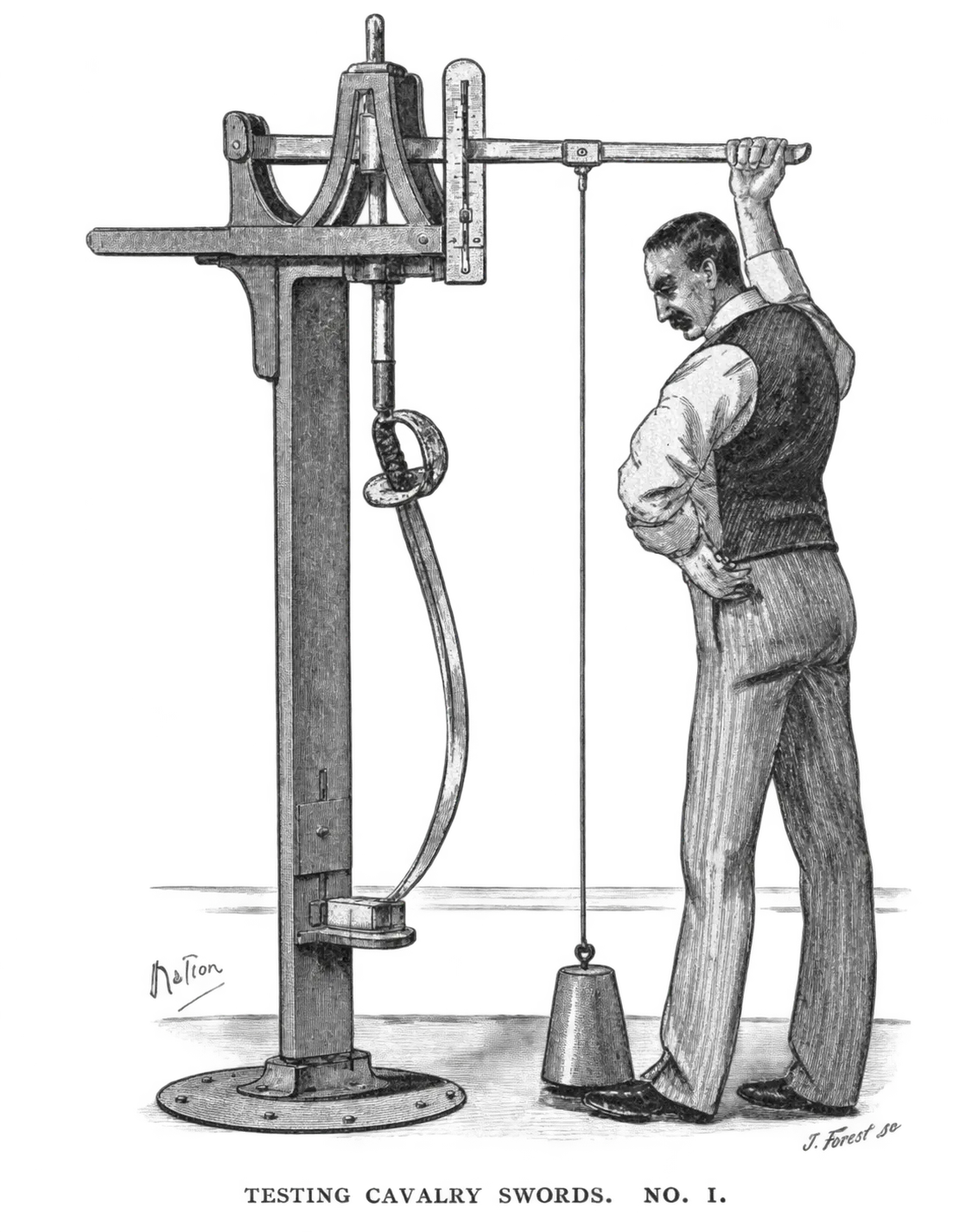
Unlike manually performed tests, such as the method demonstrated by the Polish HEMA Federation, our device reduces the influence of the operator on the direction of the applied force.
FLEX is useful for comparing training swords tested under the same conditions. However, it does not fully describe how a blade behaves during a thrust or in fencing.
FLEX and Sword Handling
Blade flexibility affects not only thrusting but also how a sword feels and responds during fencing. A stiffer blade generally provides more direct feedback and a firmer response in the bind, making it easier to sense and control pressure against an opponent’s blade.
A more flexible blade can reduce the force transmitted during a thrust. However, excessive flexibility may cause the blade to wobble or oscillate sideways during rapid movements, making the point less stable and reducing precision.
This is particularly noticeable during changes of direction, winding and blade contact, where predictable blade behaviour is essential.
The goal is not maximum flexibility, but a balance between safe thrusting, blade stability and effective sword handling.
How to Reduce Blade Flex on Your Older ENSIFER Feder

Have an older ENSIFER feder with a stiffer blade? This video shows how to make it more flexible yourself, reducing the force needed to bend it.