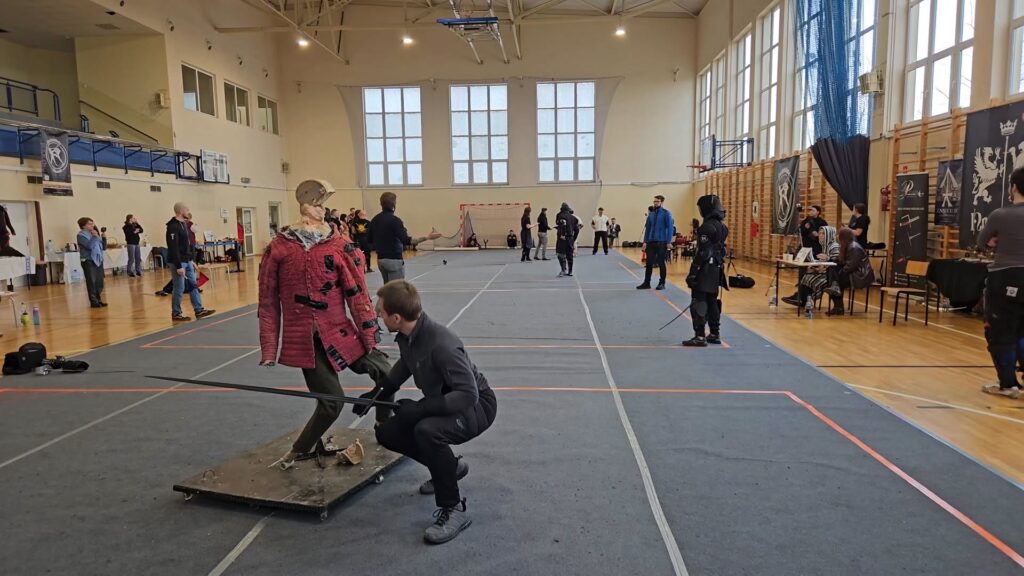
The next part of the tests on Przemysław Karcz’s dummy at Nord Fecht 2025 provided some very interesting insights.
It turned out that thrusts from Ochs that strike the sternum are often ineffective and tend to get stuck in the target. Only a transition to right or left Ansetzen from Ochs, with a full commitment, allowed the blade to pierce the target from the side of the upper chest—although there were still issues with blade extraction.
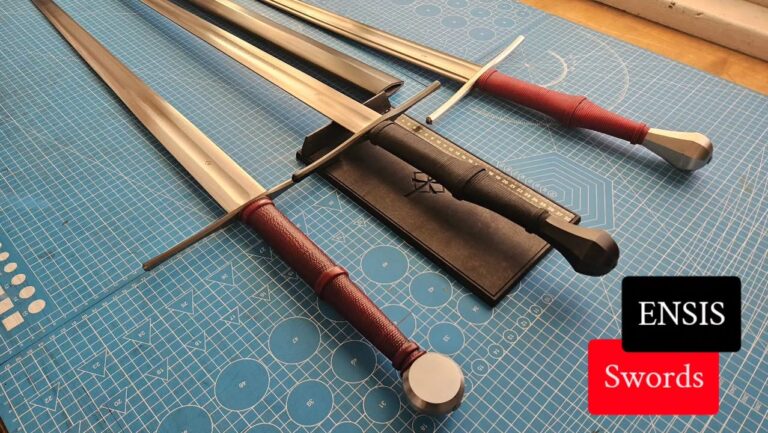
Some help came from using a second, ultra-stiff sword, kindly provided by Jakub Moszczyński, which made it easier to deliver deep thrusts.
The experiment with a dummy featuring a ribcage model made of plastic tubing clearly demonstrated the difficulties and tactical obstacles a swordsman might have encountered in a real encounter. Undoubtedly, the ability to withdraw the weapon after landing a hit was crucial.
As a side note, the Fechtschule Gdańskk logo, inspired by a Talhoffer plate, suddenly feels more relevant than ever. 😉
PL ———————————————————————
Bardzo ciekawych obserwacji dostarczyła kolejna część testów na fantomie Przemysława Karcza podczas Nord Fecht 2025.
Okazało się, że pchnięcia z Woła, które napotykają sternum, są często nieskuteczne i utykają w celu. Dopiero zmiana na prawe lub lewe Anzetzen z Woła, z pełnym zamachem umożliwiło przebicie celu z boku górnej części klatki piersiowej, choć też pojawiły się problemy z wyciągnięciem klingi.
Pewną pomocą było użycie drugiego ultra sztywnego miecza dzięki uprzejmości Jakuba Moszczyńskiego, który ułatwił zadawanie głębokich pchnięć.
Eksperyment z fantomem posiadającym model klatki piersiowej wykonanej z plastikowych rurek, uzmysławia tylko trudności i taktyczne przeszkody jakie mógł napotkać szermierz w starciu na ostre. Na pewno umiejętność oswobodzenia broni po trafieniu była kluczowa.
A tak na marginesie logo Fechtschule Gdańsk oparte na rycinie Talhoffera nabiera nowego wymiaru 😉
 Watch video on Facebook